
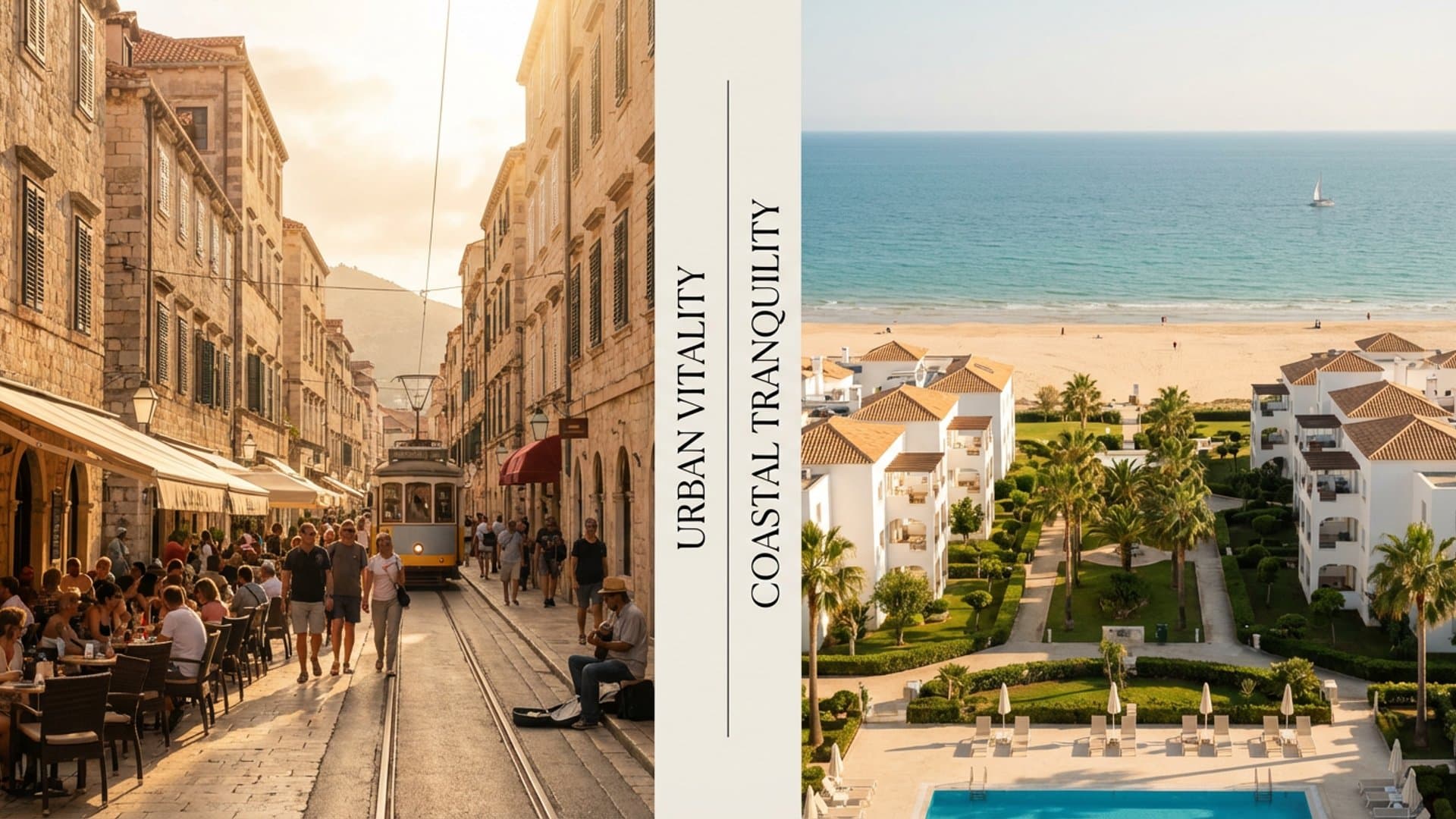
The Decision
This is the first question every international buyer wrestles with, and it shapes everything that follows: city or coast?
Málaga city and the western Costa del Sol (Marbella, Estepona, Fuengirola, Benalmádena, Torremolinos, Nerja) share the same province, the same airport, and the same Mediterranean climate. But the lifestyle they offer is fundamentally different. One is a living, working European city with museums, universities, a tech sector, and 3,000 years of layered history. The other is a string of coastal towns built around tourism, leisure, and a sun-facing lifestyle that millions of Northern Europeans have chosen as their escape.
Neither is better. They're different. And choosing the wrong one for your personality, your priorities, and your plans is the most expensive mistake you can make in this market. This guide exists to help you make that decision clearly, before you start viewing properties and fall in love with the wrong one.
Quick Comparison
| Dimension | Málaga City | Costa del Sol West |
|---|---|---|
| Cultural life | World-class — Picasso Museum, Centre Pompidou, 30+ museums, theater, live music, festivals year-round | Limited — resort entertainment, some cultural events in Marbella, heavily seasonal |
| Year-round community | Vibrant 12 months — 580,000 residents, university, tech hub | Seasonal — many areas feel empty Nov–Mar, summer population surges |
| International integration | Internationals live among locals, share neighborhoods | Expat communities often separate from Spanish daily life |
| Walkability | Excellent — Centro, Soho, La Malagueta are fully walkable | Low to moderate — most towns require a car for daily life |
| Property prices | €2,000–4,500/m² depending on neighborhood | €2,500–6,000+/m² (Marbella Golden Mile can exceed €10,000) |
| Rental yield | Strong year-round — tourists, students, professionals | High in summer, very low off-season for tourist rentals |
| Airport access | 15 minutes | 30–90 minutes depending on town |
| Public transport | Metro, bus, tram, commuter rail | Limited — car essentially required |
| Dining scene | Deep and diverse — local tapas to Michelin-level | Resort-oriented — good in Marbella, limited elsewhere |
| Healthcare | Regional hospital + multiple private clinics | Private clinics, nearest major hospital often in Málaga |
| Schools (international) | 3–5 options in the city | Numerous, especially Marbella–Estepona corridor |
| "Feel" | European city — Barcelona's younger sibling | Mediterranean resort — relaxed, sun-focused, leisure-driven |
Cultural Life & Entertainment
Málaga city has undergone one of the most dramatic cultural transformations in Europe over the past fifteen years. The Picasso Museum, Centre Pompidou Málaga, Carmen Thyssen Museum, CAC (Centre for Contemporary Art), and over thirty smaller museums and galleries have turned the city into a legitimate cultural destination. The Cervantes Theatre hosts opera, ballet, and theater year-round. Live music venues, independent cinemas, and a festival calendar that runs from January to December mean there is always something happening, always a reason to walk out your door on a Tuesday evening.
The Costa del Sol's cultural offering is concentrated in Marbella and Estepona, with occasional events in Fuengirola and Benalmádena. Marbella's old town has genuine charm and some gallery life. Estepona has invested in street art and a pleasant historic center. But beyond these pockets, the cultural landscape is thin. Entertainment on the coast is resort-oriented: beach clubs, golf, spa hotels, and seasonal events designed primarily for visitors.
If your daily happiness depends on walkable access to museums, theaters, live music, independent restaurants, and the buzz of a living city, Málaga city is the clear choice. If your ideal evening is a sunset cocktail overlooking a marina followed by dinner at a beachfront restaurant, the Costa del Sol delivers that with polish.
Year-Round Living vs Seasonal Rhythm
This is the single biggest practical difference and the one that catches buyers off-guard.
Málaga city has 580,000 year-round residents. The university adds 40,000 students. A growing tech sector (the "Málaga Tech" cluster) brings professionals. The city functions fully twelve months a year — restaurants stay open, streets stay populated, and your social life doesn't evaporate when the temperature drops in November.
Many Costa del Sol towns operate on a seasonal rhythm. From October to April, some urbanizaciones feel depopulated. Restaurants close for the winter. Your neighbors' shutters stay down for six months. If you're buying a primary residence and plan to live there year-round, the winter emptiness of some Costa del Sol areas can be genuinely isolating. Marbella's center and a few other spots maintain year-round life, but they're the exception, not the rule.
If you're buying a summer home or plan to split your year, the seasonal rhythm may suit you perfectly. If you're moving full-time, test the location in January before you commit.
International Community & Integration
Both areas have significant international populations, but the social dynamics are different.
In Málaga city, internationals — Americans, British, German, Scandinavian, Dutch — live in the same apartment buildings as Spanish families. They shop at the same markets, drink at the same bars, and their children attend the same schools. The integration is organic, partly because the city's residential neighborhoods weren't designed for foreigners — they were designed for everyone. Neighborhoods like Pedregalejo, Soho, and Centro Histórico have grown more international naturally, without losing their Spanish character.
On the Costa del Sol, international communities are larger and more established, but often more separate. Many British and Scandinavian residents live in purpose-built urbanizaciones (gated communities or residential complexes) where English is the primary language, social life revolves around the pool area and the golf club, and interaction with Spanish daily life is minimal. This isn't universally true — Marbella's old town, Estepona's center, and parts of Fuengirola have more integrated communities — but the pattern is widespread enough to be significant.
Neither model is right or wrong. Some buyers want an English-speaking comfort zone while enjoying Spanish sunshine. Others want full immersion. Know which one you are before choosing your location.
Prices & Value
Málaga city offers a wider price spectrum than the Costa del Sol, with genuine options at every budget level.
The most affordable city neighborhoods — La Paz, Huelin — offer property from €130,000 to €200,000 for a two-bedroom apartment with good transport connections. The Costa del Sol's cheapest options (inland Fuengirola, parts of Torremolinos) can match these prices but with less connectivity and fewer amenities.
At the mid-range (€250,000–450,000), Málaga city offers beachfront neighborhoods (Pedregalejo, El Palo), walkable urban living (Centro, Soho), and emerging-value areas (Huelin). The Costa del Sol at this range offers apartments in established towns — Fuengirola, Benalmádena, parts of Estepona — typically in residential complexes with communal pools and gardens.
At the premium end (€500,000+), Málaga city's La Malagueta seafront and El Limonar villas compete with Marbella and Estepona for luxury buyers. The Costa del Sol has a deeper luxury market — Marbella's Golden Mile and La Zagaleta offer a level of opulence that doesn't exist in Málaga city.
For investment, Málaga city has the edge in year-round rental yield because demand doesn't disappear in winter. Costa del Sol properties can generate high summer returns but often sit empty off-season.
Who Should Choose What
Choose Málaga city if you:
- Want a real city with culture, walkability, and year-round vitality
- Plan to live here full-time and want your social life to be consistent across seasons
- Value integrating with Spanish life rather than living in an international enclave
- Want strong public transport and don't want to depend on a car
- Are buying as a primary residence or for year-round rental income
Choose the Costa del Sol if you:
- Want a sun-and-beach lifestyle as the primary daily experience
- Are buying a vacation home or plan to be there mainly April–October
- Want access to golf, beach clubs, and a leisure-oriented social scene
- Prefer an established English-speaking international community
- Are in the ultra-premium market (€1M+) and want resort-level luxury
- Have school-age children and want the widest choice of international schools
Consider both if you:
- Want the best of both worlds — some buyers purchase in Málaga city for year-round living and use the Costa del Sol for weekend beach trips (the drive is 30–60 minutes depending on the town)
Next Step
If you are still deciding between city life and coast life, Denise can help you narrow the tradeoffs honestly before you start viewing.
If you want real examples after reading this, Denise can share selected properties from trusted partner agencies that fit the tradeoffs you care about.
Published by Denise Guerrero
FAQ
Is Málaga city or the Costa del Sol better for property investment?
For year-round rental yield, Málaga city generally outperforms. Tourist demand is strong but supplemented by students, professionals, and relocating workers who provide consistent long-term tenant demand across all seasons. Costa del Sol properties can generate high summer returns — particularly in Marbella, Nerja, and beachfront locations — but off-season vacancy rates can be significant in areas that rely purely on tourist traffic. For capital appreciation, both markets have performed well, with Málaga city growing faster in percentage terms from a lower base.
Should I buy in Málaga city if I don't speak Spanish?
Yes, it's entirely feasible. Málaga has a large enough international community and tourism infrastructure that English is widely understood in shops, restaurants, and services. The buying process can be conducted entirely in English with the right lawyer and agent. However, daily life — particularly in local neighborhoods like La Paz or El Palo — runs in Spanish, and learning the language will dramatically improve your integration and quality of life. On the Costa del Sol, particularly in British-heavy areas, you can live entirely in English without difficulty.
How far is Málaga city from the Costa del Sol beaches?
Málaga city has its own beaches — La Malagueta, Pedregalejo, and El Palo are beachfront neighborhoods within the city. You don't need to leave the city for beach access. The western Costa del Sol towns are accessible by car: Torremolinos is 15 minutes, Benalmádena 20, Fuengirola 30, Marbella 45, and Estepona 60. The eastern coast (Nerja, Rincón de la Victoria) is 25–40 minutes. Many Málaga city residents visit Costa del Sol beaches for day trips without feeling they need to live there.
Is the Costa del Sol more expensive than Málaga city?
It depends on what you're comparing. Málaga city's most affordable neighborhoods (La Paz, Huelin) are cheaper than almost anything on the coast. At the mid-range, prices are comparable. At the luxury end, the Costa del Sol — particularly Marbella — is significantly more expensive, with Golden Mile properties reaching €10,000+ per square meter. On average, you get more value per euro in Málaga city because the buyer pool includes locals, students, and professionals, not just international lifestyle buyers who inflate resort-area prices.
Do I need a car in Málaga city vs the Costa del Sol?
In Málaga city, no — particularly in Centro, Soho, La Malagueta, and Pedregalejo, where daily life is walkable and public transport covers the rest. El Limonar is the exception — a car is essential there. On the Costa del Sol, a car is essentially required everywhere except the centers of Fuengirola and Marbella. Most Costa del Sol residents drive for groceries, dining, beach access, and socializing. This is a significant lifestyle and cost difference.
What about healthcare — is it better in the city?
Málaga city is home to the Regional University Hospital, one of the largest and best-equipped public hospitals in Andalucía, plus multiple private hospitals and specialist clinics. Medical services in English are readily available. The Costa del Sol has private clinics (Hospital Costa del Sol in Marbella, various private clinics) but for serious medical issues, residents often end up in Málaga city. If access to comprehensive healthcare without a long drive matters to you — and it often matters more as buyers age — the city has a clear advantage.
Which area has better international schools?
The Costa del Sol, particularly the Marbella–Estepona corridor, has the widest selection of international schools — British, American, German, Swedish, and others. Málaga city has a smaller but growing selection, including the British School and St. George School, primarily accessible from El Limonar and Teatinos. For families prioritizing school choice above all else, the Costa del Sol offers more options. For families who prefer their children to attend Spanish-language schools for integration, both areas work well.
What's the social life like in Málaga city vs the Costa del Sol?
Málaga city's social life is diverse and year-round: rooftop bars, tapas routes, cultural events, live music, international meetup groups, and the everyday social rhythm of a functioning city. The Costa del Sol's social life is concentrated around beach clubs, golf courses, marina restaurants, and community-based activities within urbanizaciones. In summer, the coast is lively and festive. In winter, it can feel quiet. Málaga city's social calendar doesn't have an off-season.
Can I use Málaga city as a base to enjoy the Costa del Sol?
Absolutely, and many residents do exactly this. Living in Málaga city gives you year-round urban life, culture, and community, while the Costa del Sol beaches are 15–60 minutes by car for weekend trips or summer day outings. It's the "have both" strategy: city as home base, coast as playground. The reverse is less practical — living on the coast and coming into the city for culture means a drive every time.
Which area is better for retirement?
It depends on your retirement lifestyle. If you want walkable daily life, cultural stimulation, excellent nearby healthcare, and a community that doesn't shrink in winter, Málaga city — particularly Pedregalejo, Centro, or La Malagueta — is hard to beat. If you want a golf-and-beach routine, a warm and established English-speaking community, and don't mind a quieter winter social life, the Costa del Sol has been welcoming retirees for decades and does it well. Visit both in January before deciding.
Are there areas that combine city and coast qualities?
The eastern Málaga neighborhoods — Pedregalejo, El Palo — come closest to combining the two. They offer beach village character, chiringuito culture, and a community feel that resembles the smaller Costa del Sol towns, but with the city's cultural infrastructure, healthcare, and transport just fifteen to twenty minutes away. Torremolinos, technically its own municipality but adjacent to Málaga, also bridges the gap: it has its own beach and town identity while being connected to the city by commuter rail.
How do I decide between Málaga city and the Costa del Sol?
Spend a week in each — and not during peak summer when everywhere looks its best. Visit in November or February, when the tourist veneer is off and you see the location as it really is, year-round. Walk the streets at different times of day. Eat where locals eat. Check if the shops and restaurants you'd want are open. See how many people are around. The answer usually becomes clear within a few days. The wrong choice isn't a financial disaster — property markets in both areas are strong — but it's a quality-of-life mismatch that you'll feel every day. Get it right from the start. Get in touch and we can help you evaluate both options honestly.
Keep Comparing
Centro vs La Malagueta vs Soho
Choosing between Centro Histórico, La Malagueta, and Soho? Compare lifestyle, prices, walkability, and vibe to find your perfect Málaga neighborhood.
Beach Neighborhoods
Compare Málaga's three most affordable beach neighborhoods. Pedregalejo, El Palo, and Huelin offer coastal living from €150K. Find your fit.
Family Neighborhoods
Moving to Málaga with children? Compare Teatinos, El Limonar, and La Paz for schools, space, safety, and family life. Expert neighborhood guide.
Where to Buy by Budget
From €130K to €1M+ — find the best Málaga neighborhood for your budget. Every price bracket mapped to specific neighborhoods with honest expectations.
Compare Málaga with other cities
Practical buying process guides
Property Taxes Explained
Every tax you'll pay when buying and owning property in Spain: transfer tax, IBI, non-resident income tax, capital gains, and more. Complete breakdown.
What Happens After Purchase
You bought property in Málaga — now what? Setting up utilities, empadronamiento, insurance, community registration, residency steps, and ongoing obligations.