
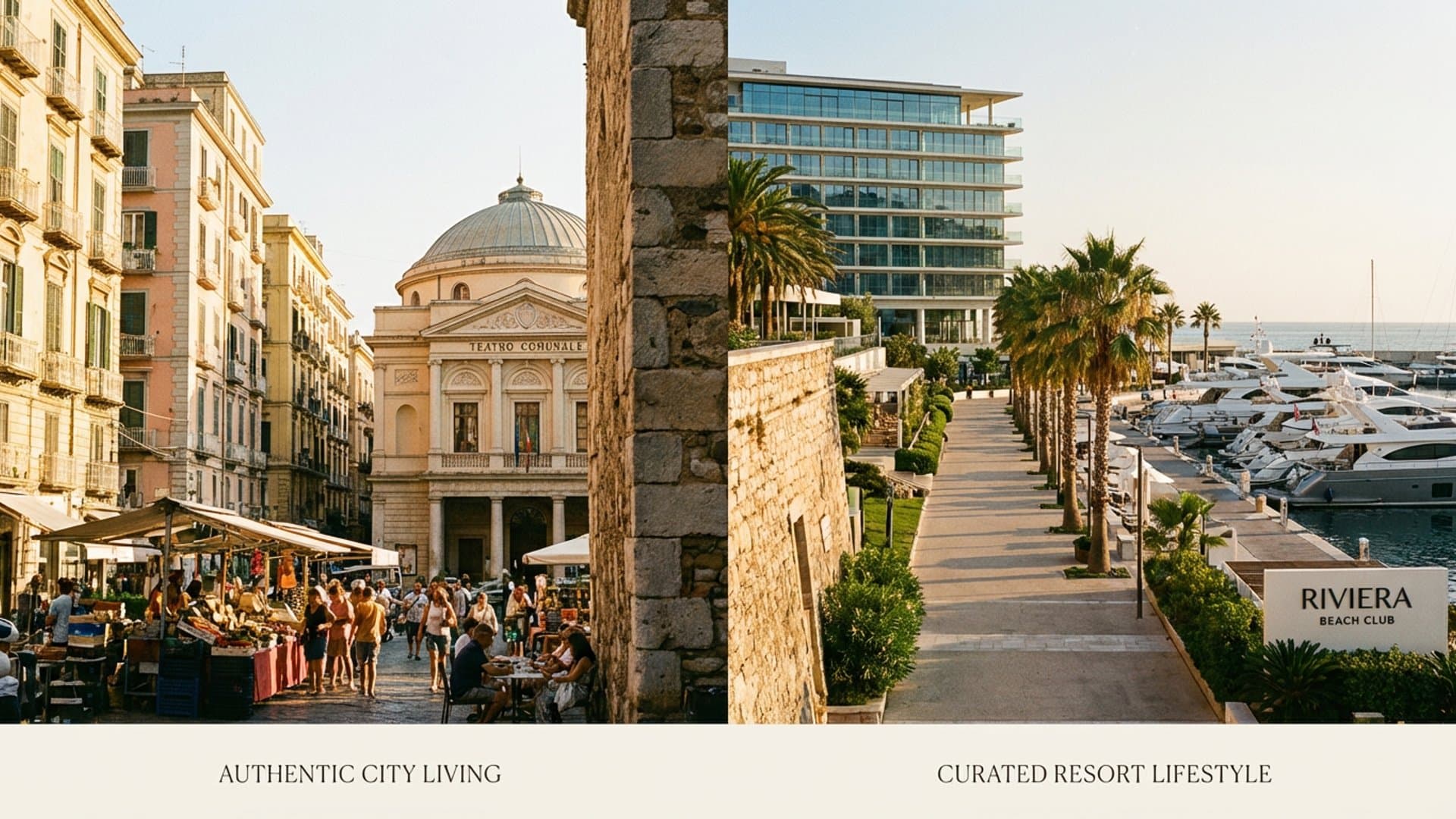
Quick Comparison
| Dimension | Málaga | Marbella |
|---|---|---|
| Population | ~580,000 | ~150,000 (swells in summer) |
| Property price/m² | €2,000–4,500 | €3,000–10,000+ |
| Year-round vibrancy | High — university, tech, culture | Seasonal — summer peaks, winter quiets |
| Beach | City beaches, chiringuitos | Resort beaches, beach clubs |
| Culture | 30+ museums, theater, music | Limited — luxury events, seasonal entertainment |
| Walkability | Excellent in central neighborhoods | Old town only — car required elsewhere |
| International community | Growing, integrated with locals | Large, established, often separate |
| International schools | 3-5 options | 10+ options (best selection on the coast) |
| Nightlife | Good urban nightlife | Seasonal, luxury-oriented (Puerto Banús) |
| "Vibe" | Working European city | Mediterranean resort town |
The Fundamental Question
Málaga and Marbella are 50 minutes apart by car, share the same province and airport, and are both marketed under the "Costa del Sol" umbrella. But the daily experience of living in each is profoundly different, and confusing the two is the single most common mistake international buyers make on the Málaga coast.
Málaga is a city. It has a university, hospitals, a tech sector, a cultural calendar, a transport system, and 580,000 people who live and work there year-round. It functions with or without tourists. Its identity doesn't depend on the season.
Marbella is a resort town. An exceptionally beautiful, well-maintained, upmarket resort town with a charming old town center — but a resort town nonetheless. Its rhythm peaks in summer and quiets dramatically in winter. Much of its economy is tourism, hospitality, and the luxury services industry. Its international community is large but often operates in a parallel world to Spanish daily life.
Property Prices
Marbella is significantly more expensive. The Golden Mile (the prestigious stretch between Marbella and Puerto Banús) regularly exceeds €6,000–10,000/m² for premium apartments and villas. Even Marbella's more accessible areas (San Pedro de Alcántara, Nueva Andalucía) run €3,000–5,000/m². A two-bedroom apartment in a good location costs €350,000–500,000+.
In Málaga, the same budget opens doors to premium seafront in La Malagueta (€350K–500K), spacious villas in El Limonar (€400K+), or character apartments in Centro Histórico (€280K–400K). The value proposition is clear: Málaga offers comparable or superior quality of daily life at a lower price point.
Year-Round Living
This is the most important practical difference. Málaga thrives twelve months a year. Restaurants stay open, streets stay populated, cultural events continue, and your social life doesn't evaporate when temperatures drop.
In Marbella, many restaurants close for winter. Some urbanizaciones empty out as seasonal residents return to Northern Europe. The beach clubs that define summer social life shut their doors from October to April. If you're there year-round, winter can feel isolating, particularly in the areas outside the old town.
Marbella's old town is the exception — it maintains year-round life, charm, and a functioning community. But it's a small area, and the broader Marbella experience is significantly seasonal.
Choose Málaga if...
- You want a real city that functions year-round
- Cultural depth — museums, theater, live music — matters to your daily life
- You value integrating with Spanish culture, not living in an international bubble
- You want better value per euro for your property
- Walkability and public transport matter — you don't want to depend on a car
Choose Marbella if...
- The luxury resort lifestyle is what you want — beach clubs, golf, marina dining
- International school choice is the top priority (Marbella has 10+ options)
- You're in the ultra-premium market (€1M+) and want resort-level properties
- Summer is your primary season — you'll be elsewhere in winter
- A large, established English-speaking community from day one is important
Next Step
If you are choosing between Málaga city life and the Marbella market, Denise can help you compare the day-to-day reality with much more context.
If you want real Málaga examples while you compare the Costa del Sol tradeoffs, Denise can share selected properties from trusted partner agencies.
Published by Denise Guerrero
FAQ
Is Málaga or Marbella more expensive?
Marbella is significantly more expensive. Average prices in Marbella range from €3,000 to €10,000+/m² depending on location. Málaga ranges from €2,000 to €4,500/m². The premium for Marbella reflects its luxury brand, resort infrastructure, and the international demand for Golden Mile and beachfront properties. For equivalent spending, Málaga offers a larger property in a more complete city environment.
Can I live in Marbella year-round?
Yes, people do — Marbella has permanent residents and a functioning local government. But the experience is seasonal. Winter in Marbella, particularly outside the old town, can feel quiet and isolated compared to summer's energy. Many restaurants, shops, and social venues operate seasonally. If you plan to live somewhere twelve months a year and want consistent social life and services, Málaga is the stronger choice.
Which has better international schools?
Marbella has the widest selection of international schools on the entire Costa del Sol — British, American, Swedish, German, Finnish, and IB curriculum schools. It's the clear winner for families prioritizing school choice. Málaga's international school options are fewer but growing, concentrated near El Limonar and Teatinos.
Do I need a car in Marbella?
Yes, for virtually everything outside the old town. Marbella is spread along the coast with limited public transport. Daily life — groceries, school, restaurants, beach — requires driving. Málaga's central neighborhoods (Centro, Soho, La Malagueta, Pedregalejo) are walkable without a car.
Which is better for investment?
Málaga offers better value and more diverse demand drivers (tourism, professionals, students, tech workers, retirees). Marbella's luxury market is more volatile — it peaks in good times and contracts sharper in downturns. For yield-focused investment, Málaga's year-round rental demand is more consistent. For ultra-luxury appreciation, Marbella's top-tier properties have historically performed well over long holds.
How far apart are Málaga and Marbella?
Approximately 50 minutes by car via the AP-7 motorway (toll road) or A-7 coast road. Some Málaga residents visit Marbella for weekend beach club visits or dinner. Living in Málaga and "using" Marbella occasionally is a popular strategy for buyers who want city life but access to the resort coast.
Which has better beaches?
Different, not better. Marbella's beaches are resort-style: wide, well-serviced, backed by beach clubs and luxury hotels. Málaga's beaches are city-style: La Malagueta's urban sand, Pedregalejo's charming coves, El Palo's fishing village coast. If you want beach clubs and sunbeds, Marbella. If you want neighborhood beaches integrated into daily life, Málaga.
Which has more cultural activities?
Málaga, by a wide margin. Thirty-plus museums, a theater scene, live music venues, independent cinema, and a year-round festival calendar. Marbella's cultural offering is limited — some galleries, seasonal events, and the Starlite music festival in summer. If cultural life is important to your happiness, the choice is clear.
Is Marbella's old town worth considering?
Yes — Marbella's old town (Casco Antiguo) is genuinely charming: whitewashed buildings, orange trees, Plaza de los Naranjos, excellent restaurants, and a more year-round community feel than the rest of Marbella. Property there is expensive (€3,500–5,000+/m² for renovated apartments) but offers a lifestyle that bridges the gap between Málaga's urban character and Marbella's resort appeal. It's the closest thing Marbella has to a "neighborhood" in the Málaga sense.
Can my children attend Marbella schools if I live in Málaga?
Technically yes, but the daily commute (50+ minutes each way) makes it impractical. For families who need Marbella's international school options, living nearby (Nueva Andalucía, San Pedro, Estepona) is the practical solution. Málaga's own international schools are the viable option for families based in the city.
Which is safer?
Both are generally safe. Marbella has some association with organized crime and money laundering in media reporting, though this doesn't typically affect daily life for residents. Málaga is a working city with standard urban safety considerations. Neither presents unusual safety concerns for international residents.
Which should I visit first?
If you're starting your search, visit Málaga first. It takes longer to understand — the cultural layers, the neighborhoods, the daily rhythm need exploration. Marbella reveals itself faster: you'll know within a day or two whether the resort lifestyle is for you. Spend three to four days in Málaga experiencing different neighborhoods, then drive to Marbella for a day or two. The contrast will clarify your priorities. Get in touch and we'll arrange a focused property viewing itinerary.
Keep Comparing
Málaga vs Barcelona
Choosing between Málaga and Barcelona? Honest comparison of property prices, lifestyle, climate, culture, and value for international buyers.
Málaga vs Valencia
Málaga or Valencia? Compare property prices, beach access, cost of living, international community, and lifestyle for buyers choosing between Spain's two coastal cities.
Málaga vs Alicante
Málaga or Alicante? Compare property prices, climate, beach life, and lifestyle for international buyers choosing between Spain's sunniest coastal cities.
Málaga vs Lisbon
Choosing between Málaga and Lisbon? Compare property prices, climate, visa options, culture, and lifestyle for international buyers exploring the Iberian Peninsula.
Málaga vs Madrid
Málaga or Madrid? Compare lifestyle, property prices, career opportunities, climate, and culture for international buyers choosing between Spain's capital and its sunniest coastal city.