
Key Info Box
•
•--
💰Price advantage
🕐Typical delivery
📋Legal protection
⚠️Key risk
What Buying Off-Plan Means
Buying off-plan (compra sobre plano) means purchasing a property that hasn't been built yet — or is in the early stages of construction. You agree to buy based on architectural plans, showroom displays, and marketing materials, and you pay in stages as construction progresses. When the building is complete (typically 18 to 36 months later), you receive the finished property and sign the escritura.
The appeal is straightforward: you buy at today's prices for a property delivered in the future, often at a 5-15% discount to what the completed property will be worth when finished. In a rising market like Málaga's, the property can appreciate during the construction period, meaning you've built equity before you've even received the keys.
The risks are equally straightforward: the building might be delayed, the finished product might differ from the showroom promise, and in extreme cases, the developer might fail to deliver entirely. Spanish law provides protections — but only if they're properly in place, which your lawyer must verify.
How the Process Works
Step 1: Reservation. You pay a small reservation fee (€3,000–10,000) to take the property off the market. This is typically refundable if you decide not to proceed after reviewing the full contract. It reserves a specific unit (floor, orientation, layout) from the development.
Step 2: Contract signing (contrato de compraventa). You sign a purchase contract and pay an initial deposit, typically 20-30% of the purchase price. This is where legal protection matters most — your lawyer must verify the bank guarantee or insurance policy protecting your deposit (see Legal Protections below).
Step 3: Stage payments. Additional payments are made at construction milestones (foundation complete, structure complete, etc.) — typically 10-20% of the price at each stage. The exact schedule is defined in the contract.
Step 4: Completion and delivery (entrega de llaves). When construction is finished, the developer obtains the Licencia de Primera Ocupación (First Occupancy License), and you sign the escritura at the notary, paying the remaining balance (typically 50-60% of the total price, often via mortgage). You receive the keys.
Legal Protections — This Is Non-Negotiable
Spanish law (Ley 38/1999 de Ordenación de la Edificación and subsequent updates) requires developers to protect buyer deposits through one of two mechanisms:
Bank guarantee (aval bancario): A bank guarantees the return of your money if the developer fails to deliver the property or delivers it late beyond the contracted date. The guarantee covers all amounts you've paid.
Insurance policy (seguro de caución): An insurance company guarantees the same — return of all funds if the developer fails to deliver.
Your lawyer must verify that one of these protections is in place BEFORE you make any payment beyond the initial reservation. This is the single most important check in an off-plan purchase. Without it, your money is effectively unsecured — and if the developer goes bankrupt, recovering your funds becomes a lengthy legal battle.
Do not accept excuses. Do not accept a promise that "the guarantee will be arranged later." Do not accept a contract that doesn't explicitly reference the bank guarantee or insurance policy. No guarantee, no payment. Period.
What to Check Before Buying
The developer's track record. Research the developer's previous projects. Visit completed developments if possible. Check the Registro Mercantil (commercial registry) for the company's financial filings. Ask the developer directly for references from buyers in previous projects. A developer with a track record of completed, quality developments is meaningfully less risky than a first-time operation.
The building permits. Verify that the development has a valid Licencia de Obra (building permit) from the Ayuntamiento. Without this, construction cannot legally proceed, and the entire timeline is at risk. Some developers begin selling before permits are fully granted — this adds risk.
The contract details. Your lawyer reviews: the exact unit specification (size, layout, orientation, floor, parking space, storage room), the materials and finishes (brand names, not just descriptions), the completion date and penalty clauses for delays, the deposit protection mechanism, the payment schedule, and the conditions under which you can terminate.
The projected community fees. Developers provide estimated community fees for the completed building. These are often optimistic (low) — actual fees once the building is operational and the community sets its real budget may be higher. Budget conservatively.
Price Advantage vs Risks
The price advantage:
Off-plan properties typically sell at 5-15% below what the completed equivalent would cost on the open market. In a market appreciating at 5-10% annually (as Málaga has recently), an 18-month construction period can add further value — you might be sitting on 10-20% paper appreciation before you receive the keys.
The risks:
Delivery delays: construction in Spain frequently overruns. A 6-12 month delay is common. If you're planning around a specific move date, build buffer time. The contract should include penalty clauses for developer delays — but enforcing them is slower than the delay itself.
Quality differences: the showroom and marketing renders may not exactly match the delivered product. Tile colors differ slightly, views are obstructed by a structure that wasn't in the renders, the "spacious terrace" is smaller than it appeared. Your contract should specify materials by brand and model number, not just "high-quality ceramic tiles."
Developer insolvency: the worst case. The bank guarantee or insurance should protect your deposits, but the process of recovery takes time. Buying from an established developer with a track record reduces (but doesn't eliminate) this risk.
Market reversal: if property values decline during the construction period, you receive a property worth less than you paid. The deposit protection covers developer failure, not market depreciation. This risk exists but is moderated in supply-constrained markets like central Málaga.
Where Off-Plan Is Available in Málaga
Off-plan developments in Málaga city are concentrated in:
Teatinos: the most active new-build area, with several developments offering modern apartments with communal pools, parking, and proximity to the tram.
Huelin: new developments near the renovated promenade, benefiting from the area's improving infrastructure and tram connection.
Western expansion areas: larger developments between the city and the airport, offering more suburban-style properties.
Occasionally, boutique developments (4-10 units) appear in more central areas — typically full rehabilitation of an existing building rather than ground-up construction. These are rare and sell out quickly.
Off-plan is NOT available in Centro, Soho, La Malagueta, Pedregalejo, El Palo, or El Limonar — these neighborhoods are fully built out.
Common Mistakes to Avoid
Mistake 1: Paying without verifying the bank guarantee. Cannot be stressed enough. No guarantee = no payment.
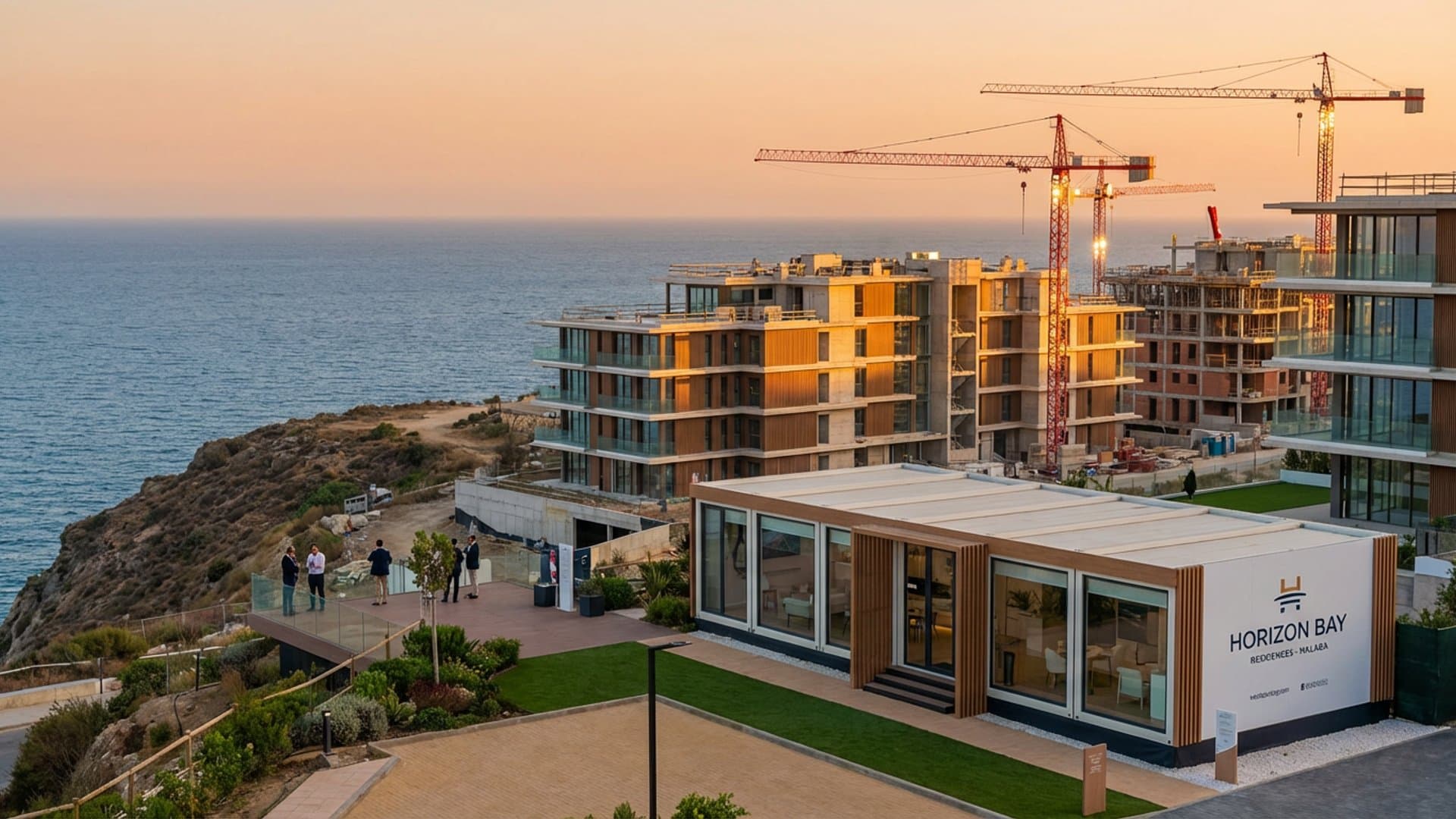
Mistake 2: Choosing based on renders alone. Visit the development site. Check the actual views from the building's footprint. Walk the neighborhood. Marketing renders make every development look like a resort — reality may differ.
Mistake 3: Not factoring in the total cost. The purchase price is only part of the cost. Add: 10% IVA + 1.5% AJD (11.5% total tax), notary and registry fees, legal fees, and potential upgrade costs if you customize finishes. Total transaction costs are approximately 13-15% of the purchase price for new builds.
Mistake 4: Ignoring the community setup. In a new building, the community of owners doesn't exist yet — it's formed after delivery. The initial community fees, rules, and management are proposed by the developer. The actual fees and governance will be determined once owners move in and hold their first general meeting. This uncertainty is a minor but real factor.
This page is general guidance only and should not be treated as legal, tax, or investment advice. For a specific purchase, consult a qualified Spanish lawyer and the appropriate professionals for your situation.
Next Step
If you are considering buying before completion, Denise can help you compare the upside, the timeline, and the legal checks that matter most.
If you want to review selected off-plan and near-completion opportunities, Denise can share current options from trusted partner agencies.
Published by Denise Guerrero
FAQ
What does "off-plan" mean in Spain?
Off-plan (sobre plano) means buying a property that hasn't been built yet, based on architectural plans and showroom materials. You pay in stages during construction and receive the finished property when complete (typically 18-36 months). It's a common way to buy new-build apartments in Spain, often at a discount to the completed market price.
Is buying off-plan risky?
There are real risks: delivery delays, quality discrepancies, and developer insolvency. However, Spanish law mandates deposit protection through bank guarantees or insurance, which covers the financial risk of non-delivery. The key is ensuring this protection is verified by your lawyer before making any payment. With proper due diligence and legal oversight, the risks are manageable.
How much deposit do I need?
Typically 20-30% of the purchase price, paid in stages. An initial reservation (€3,000-10,000) secures the unit, followed by the main deposit at contract signing, and then stage payments at construction milestones. The final payment (50-60%) is made at completion and can be financed through a mortgage.
What happens if the developer goes bankrupt?
If the bank guarantee or insurance policy is in place (which it must be, by law), you're entitled to a full refund of all amounts paid. The guarantor (bank or insurer) returns your money. The process can take weeks to months but the protection is real. If the guarantee wasn't in place (which means your lawyer failed in their primary duty), recovery becomes a much more difficult legal process.
Can I get a mortgage for an off-plan purchase?
Yes. You don't need the mortgage until completion — during construction, you're paying deposits from your own funds. When the building is complete, you arrange a mortgage for the final payment (50-60% of the price). Some developers have arrangements with specific banks, but you're not obligated to use the developer's bank — shop around.
Can I sell my off-plan unit before completion?
In some cases, yes — through an assignment (cesión) of your purchase contract to a new buyer. The developer must typically consent to the assignment, and there may be a fee. If the market has appreciated during construction, you can potentially sell your position at a profit without ever taking delivery. However, this is subject to the specific contract terms and tax implications (the profit is taxable).
What taxes do I pay on an off-plan purchase?
Off-plan purchases are new builds, so: 10% IVA (VAT) + 1.5% AJD (stamp duty) in Andalucía = 11.5% total on the purchase price. Plus notary fees, registry fees, and legal fees (approximately 2-3% additional). Total transaction costs: approximately 13-15% of the purchase price. See the property taxes guide.
How do I choose between different off-plan developments?
Evaluate: the developer's track record (previous projects completed on time and to quality), the location (neighborhood, transport, amenities), the specific unit (floor, orientation, views, layout), the price per square meter compared to completed properties nearby, the community amenities (pool, gym, parking), and the delivery timeline. Visit the site in person and walk the surrounding neighborhood.
What if the finished property doesn't match the plans?
Minor deviations are common and usually covered by the contract's tolerance clauses. Significant differences (substantially smaller size, different materials, changed layout) may constitute a breach of contract. Your lawyer reviews the delivery against the contract specifications. Spain's warranty protections (1/3/10 year) also apply to defects discovered after delivery.
How long do off-plan developments take in Málaga?
Typical construction: 18-36 months from purchase to delivery. Delays of 3-12 months are common in Spain due to permitting, weather, labor shortages, or supply chain issues. Build buffer time into your plans — don't book movers based on the developer's optimistic timeline.
Can I visit the construction site during building?
Most developers allow periodic site visits, particularly at milestone stages (structure complete, first fix, final fit-out). Some organize formal buyer visits. Visiting during construction gives you a sense of progress, quality, and the reality of the views and orientation — which may differ from marketing renders. Take photos for your records.
Is off-plan a good idea for first-time buyers in Spain?
It can work well — you get a new, modern property with warranties and no renovation needed. But the process is more complex than buying an existing property: longer timeline, more legal checks, stage payments over months, and the uncertainty of buying something you can't walk through. First-time buyers should have excellent legal support and realistic expectations about timelines. If you want certainty and simplicity, buying an existing resale property you can visit and evaluate in person may be a better starting point. Contact me and I'll help you decide which approach fits your situation.
END OF CONTENT DOCUMENT
6 property type guide pages — English versions, publication-ready.
Spanish versions: ES routes should redirect to EN for now (same pattern as city comparisons).
Spanish content will be provided in a follow-up batch.
Ready to narrow down your search?
Find which neighborhoods match your situation before you keep touring properties.
More property type guides
Penthouses
Terraces, views, ownership checks, and where penthouse buyers should focus in Málaga.
New Build vs Resale
How to compare taxes, location, condition, and long-term fit between new build and resale.
Townhouses
Space, layouts, neighborhood fit, and what to watch when comparing townhouses in Málaga.
Renovation Projects
When a reform project makes sense, what it really costs, and where the upside is strongest.
Investment & Rental
Yield, regulation, tenant profile, and which Málaga areas fit different rental strategies.