
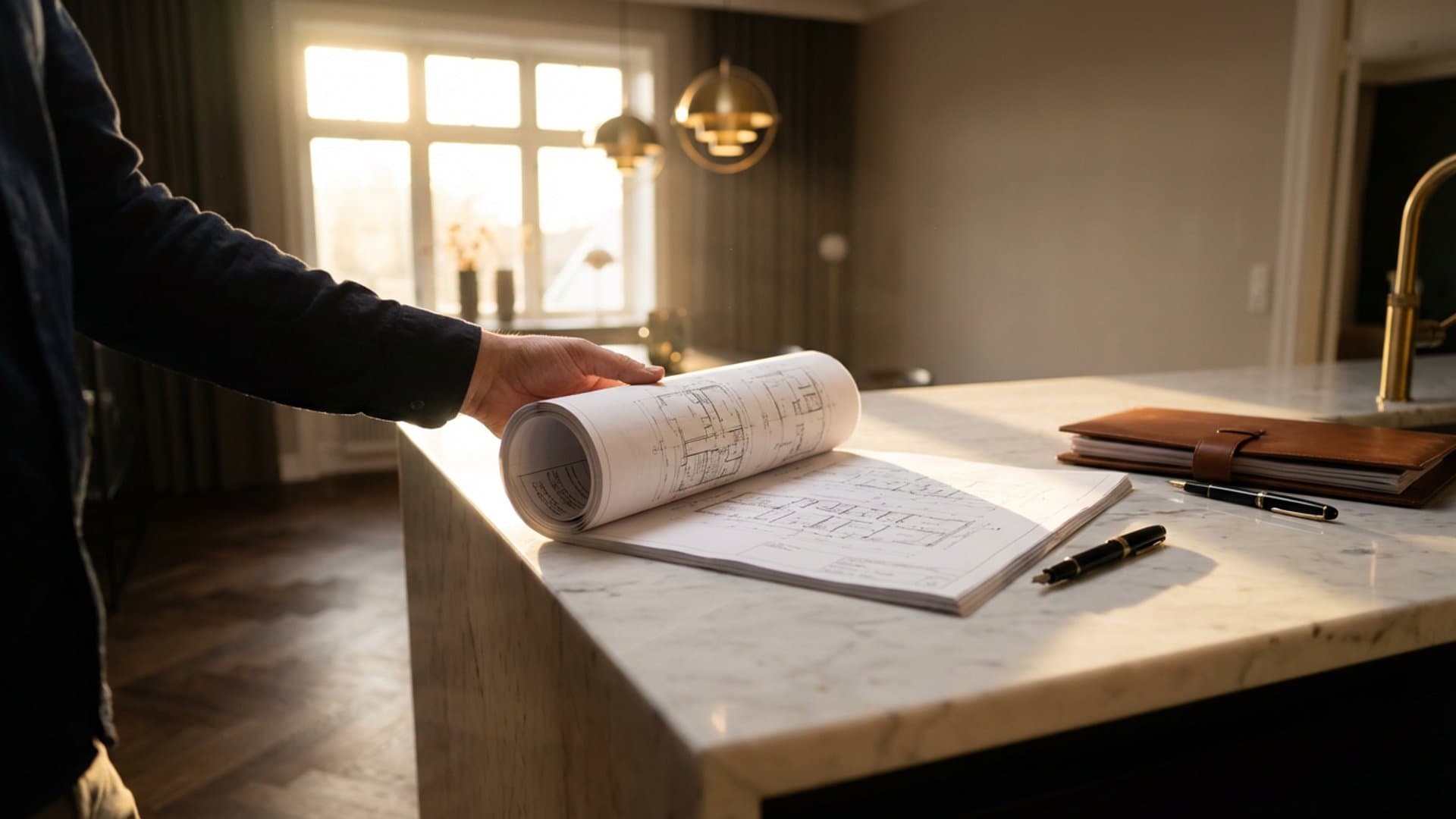
What Due Diligence Means in Practice
Due diligence isn't a single step. It's a series of checks, questions, and verifications that happen at different stages of the buying process — some during viewings, some between offer and completion, and some that your lawyer handles on your behalf.
For a standard apartment in a well-maintained modern building, the due diligence is relatively straightforward: your lawyer verifies ownership, checks for debts and charges, confirms planning compliance, and reviews the community-of-owners documentation. These checks are essential and non-negotiable regardless of the property's value.
For higher-value properties, additional layers matter. The renovation might look impressive, but was it permitted? The building has historic character, but does it also have structural issues hidden behind new finishes? The penthouse has a private terrace, but is it legally registered as part of the property, or is it a common area that's been informally claimed? The community of owners says the building is well managed, but the reserve fund tells a different story.
None of these issues are unusual in Málaga — or anywhere in Spain. They're the kind of thing that a careful buyer catches before committing, not after. The goal of due diligence isn't to find reasons not to buy. It's to make sure you understand exactly what you're buying.
Your lawyer handles the legal and administrative verification. Denise helps you ask the right questions during viewings and flags the practical considerations that legal documents alone don't reveal. Together, they give you a more complete picture than either could alone.
Questions to Ask During Viewings
Viewings are when you gather information that doesn't appear in listings or legal documents. For higher-value properties, the questions go deeper.
About the renovation. If the property has been renovated, ask what was done and when. Was the work licensed? Were structural elements modified? Who did the work — a reputable firm, or an informal arrangement? Are there guarantees on the work? A beautiful finish means nothing if the plumbing behind it was done without permits.
About the building. How old is the building? When was the roof last replaced or repaired? What's the condition of the communal plumbing, electrical, and elevator systems? Has the building passed its ITE (Inspección Técnica de Edificios) if applicable? Are there any planned derrama (special assessments) for major repairs?
About the community of owners. How many units are in the building? What proportion are owner-occupied versus rental? Are there any ongoing disputes? What are the annual community fees, and what do they cover? Is there a healthy reserve fund? How active and well-organized is the community?
About noise and light. Visit at different times of day if possible. Morning light and evening noise are different experiences. Check the orientation — north-facing apartments in Málaga can be surprisingly dark. Listen for street noise, bar noise, and building noise. In historic buildings, sound insulation between apartments is often minimal.
About outdoor space. If the property includes a terrace, rooftop, or patio, confirm whether it's private, communal, or an informal arrangement. Ask whether any outdoor modifications (enclosures, pergolas, installations) were permitted. Unpermitted additions can become liabilities.
About parking and storage. If included, confirm that the parking space and storage unit are registered as part of the property in the Land Registry, not simply assigned informally by the community.
These questions aren't about being suspicious. They're about being thorough — and they're the kind of thing that separates a confident purchase from an anxious one.
Questions to Ask Before Making an Offer
Once you've seen a property you're seriously considering, a second layer of questions applies. These are typically addressed by your lawyer, but knowing what to expect helps you stay informed.
Legal ownership verification. Is the seller the registered owner? Are there any co-owners? Is the property free of charges, liens, or encumbrances? Your lawyer obtains a nota simple from the Land Registry to verify this.
Debts attached to the property. Are there unpaid community fees, utility bills, or tax arrears? In Spain, certain debts can transfer with the property. Your lawyer checks for these specifically.
Planning and zoning compliance. Does the property comply with current planning regulations? Were any modifications (extensions, conversions, terrace enclosures) properly licensed? If not, what are the implications — can they be regularized, or do they represent a legal risk?
Energy performance certificate. Spanish law requires an energy certificate for property sales. It's not just a formality — it gives you a sense of the property's insulation quality and energy costs.
Community-of-owners review. Your lawyer should review the community minutes from recent years to check for planned works, ongoing disputes, financial health, and any restrictions that might affect your use of the property.
Structural survey. For older buildings or properties with visible wear, a structural survey by an independent architect or surveyor can identify issues that aren't visible to the untrained eye. This is optional but worth considering for higher-value purchases.
Tax implications. Your lawyer or tax advisor should clarify the applicable taxes — transfer tax or VAT, annual property tax, non-resident income tax if applicable — and any implications specific to your nationality and residency status. The buying in Spain overview covers the general tax framework.
This is not an exhaustive list, and the specifics vary by property. Your lawyer will tailor the due diligence to the particular situation. The point is that you should expect this level of scrutiny — and be wary of any process that skips it.
How Denise Helps Coordinate the Process
Denise is not a lawyer, surveyor, or tax advisor, and she doesn't provide advice in any of those areas. What she does is coordinate — making sure the right professionals are involved at the right time and that their findings reach you in a way that's clear and actionable.
She flags concerns early. During viewings, Denise points out practical issues that warrant further investigation — renovation quality, building condition, community dynamics, unusual arrangements. These observations often prompt the specific questions your lawyer then investigates formally.
She connects you with specialists. Lawyers who handle complex property transactions, independent architects for structural assessments, tax advisors for cross-border implications — Denise maintains working relationships with professionals who specialize in higher-value and more complex purchases.
She keeps the timeline organized. Due diligence involves multiple parties working in parallel — your lawyer, the seller's side, the community administrator, potentially a surveyor or architect. Denise coordinates the communication so nothing stalls or gets lost between parties.
She translates complexity into clarity. When your lawyer's report comes back with findings, Denise helps you understand what matters, what's normal, and what needs further attention. She doesn't interpret legal documents — she helps you ask the right follow-up questions.
She protects your time. By flagging potential issues before you reach the offer stage, Denise helps you avoid investing time and legal costs in properties that would have failed due diligence anyway. The filtering happens earlier, which saves you money and energy.
Her role is to make the process feel organized rather than overwhelming — so you can focus on whether the property is right, confident that the technical and legal checks are being handled properly.
Your Next Step
If you're looking at higher-value properties in Málaga — or any property where the details matter more than usual — start with a conversation. Get in touch with Denise to discuss what you're looking for and how the due diligence process works for your specific situation.
You can also browse the listings to start identifying properties that interest you.
Published by Denise Guerrero
FAQ
What is due diligence in the context of buying property in Spain?
It's the process of verifying a property's legal status, physical condition, and financial standing before you commit to buying. Your lawyer handles the legal checks; additional professionals may handle structural or technical assessments. It happens primarily between the arras (deposit contract) and the final signing, though some checks should start during viewings.
Is due diligence different for higher-value properties?
The core checks are the same, but higher-value properties often involve additional layers — structural surveys, detailed community-of-owners analysis, renovation permit verification, and more thorough planning compliance checks. The stakes are higher, and the complexity tends to be greater.
Who handles due diligence — Denise or a lawyer?
Your lawyer handles the legal and administrative due diligence. Denise coordinates the process and flags practical concerns during viewings that prompt further investigation. She also connects you with independent architects, surveyors, or tax advisors when needed. She does not provide legal, structural, or tax advice herself.
What are the most common issues found during due diligence in Málaga?
Unpermitted renovations or modifications, community-of-owners with financial problems or planned special assessments, unclear terrace or rooftop ownership, debts attached to the property, and discrepancies between the registered description and the physical reality. None of these are unusual — they're what due diligence is designed to catch.
Should I get a structural survey?
For older buildings or properties with visible wear, yes — an independent structural assessment by a qualified architect or surveyor is worth the investment. For newer construction in good condition, it may not be necessary, but your lawyer or Denise can advise on a case-by-case basis.
How do I know if a renovation was done legally?
Your lawyer checks whether the work had the required licenses and whether the changes are reflected in the property's registry description. During viewings, Denise looks for signs of quality and asks about the renovation history. If there's any doubt, a more detailed investigation is warranted.
What is a derrama?
A derrama is a special assessment levied by the community of owners for major repairs or improvements — roof replacement, elevator modernization, façade work. If one is planned or in progress, it can significantly affect your costs after purchase. Your lawyer reviews the community minutes to check for this.
Can debts from the previous owner transfer to me?
Certain debts can. Unpaid community fees from the current and previous year, and some tax debts, can attach to the property rather than the owner. Your lawyer specifically checks for these before you sign.
What if due diligence reveals a problem?
It depends on the problem. Some issues are dealbreakers. Others can be resolved — through price negotiation, remediation requirements, or legal regularization. Your lawyer advises on the options. Having this information before you commit is the entire point of due diligence.
How long does due diligence take?
Typically two to four weeks for standard checks. More complex situations — structural surveys, planning investigations, multi-party ownership — can take longer. The timeline is usually built into the period between the arras and the escritura. Contact Denise to discuss timing for your specific situation.
How much does due diligence cost?
Legal fees vary by lawyer and complexity. A standard property transaction might include legal due diligence within the lawyer's overall fee. Additional costs — structural surveys, specialist reports — are separate. Your lawyer provides an estimate upfront. The cost of thorough due diligence is small relative to the cost of discovering a problem after purchase.
Can I skip some of these checks to speed up the process?
You can, but it's not advisable — especially for higher-value properties. Each check exists because the corresponding risk is real. Skipping steps to save time can cost significantly more if a problem emerges later. A good lawyer and an organized process — which is what Denise helps with — keeps due diligence thorough without making it slow.