
Key Info Box
•
•--
💰Typical range (Málaga apartment)
📋What they cover
⚠️What to check
📄Key document
What Are Community Fees?
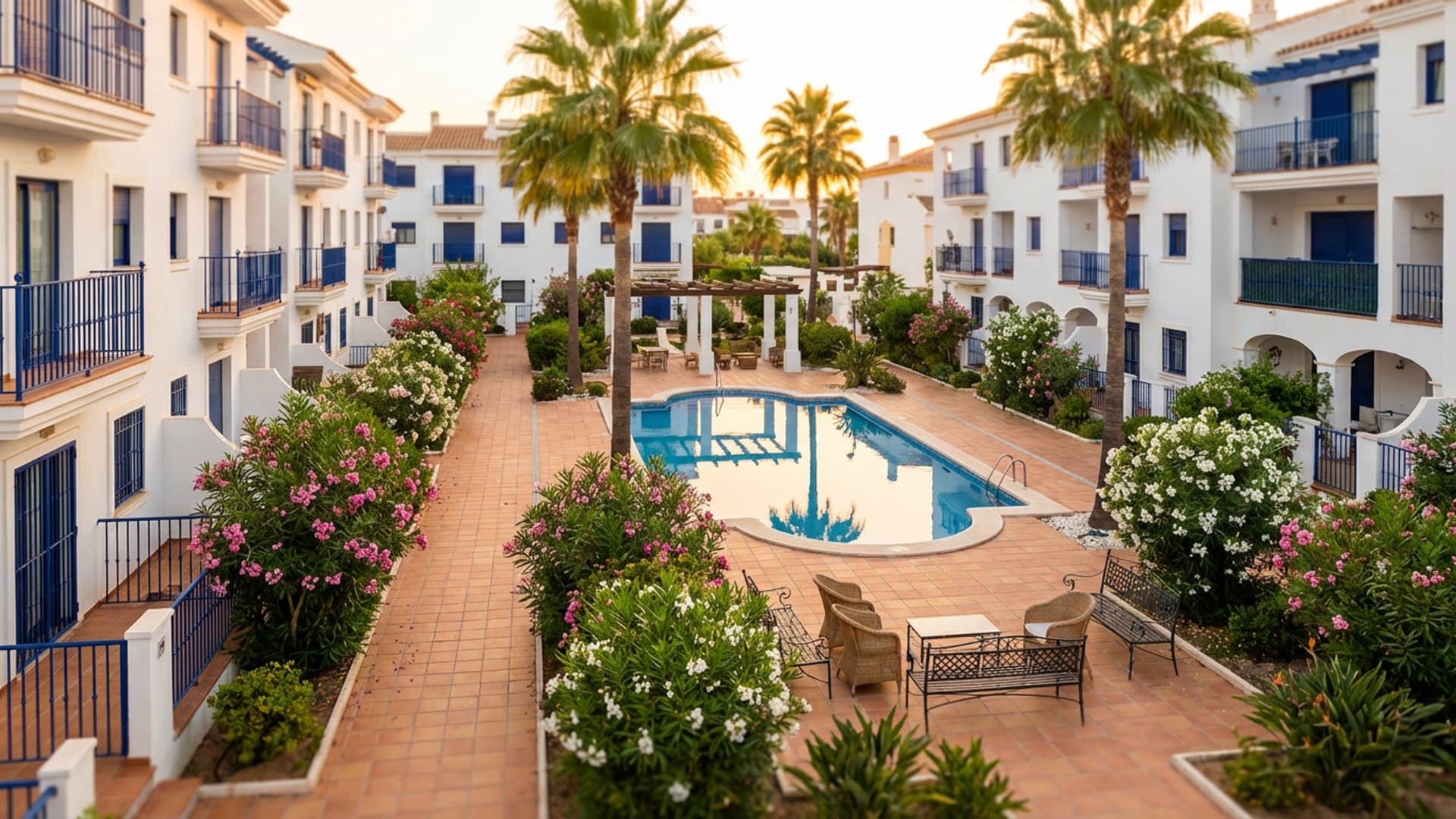
If you're buying an apartment, a townhouse in a complex, or any property that shares common elements with other owners, you'll pay community fees (gastos de comunidad or cuota de comunidad). These monthly payments fund the maintenance and upkeep of the shared building: stairways, elevator, facade, roof, communal gardens, swimming pool, insurance, cleaning, lighting in common areas, and any other shared infrastructure.
Every building with multiple owners in Spain is legally required to have a Comunidad de Propietarios (Community of Owners) — essentially a homeowners' association. The community is governed by the Ley de Propiedad Horizontal (Horizontal Property Law) and operates through annual general meetings where owners vote on budgets, approve expenditures, and elect a president and administrators.
For international buyers accustomed to homeowner association fees in the US, strata fees in Australia, or service charges in the UK, the concept is familiar. The details, however, are specific to Spanish law and worth understanding before you buy.
How Much Do Community Fees Cost?
The range in Málaga is wide, driven primarily by the building's amenities and condition:
| Building Type | Typical Monthly Fee |
|---|---|
| Basic apartment block (no pool, no elevator, 4-6 units) | €30–60 |
| Standard apartment block (elevator, intercom, basic maintenance) | €50–100 |
| Modern building (elevator, pool, garden, security cameras) | €100–180 |
| Premium complex (pool, gym, concierge, landscaped gardens) | €150–250+ |
| Villa in gated community | €150–300+ |
Community fees are calculated based on each owner's cuota de participación — a percentage share of the community that's assigned to each property based on its size relative to the whole building. A larger apartment pays proportionally more than a smaller one.
What They Cover
A well-managed community budget typically includes:
Routine costs: building insurance (mandatory), cleaning of common areas, elevator maintenance contract, lighting in hallways and entrance, intercom/video entry system maintenance, pest control, basic repairs and maintenance.
If the building has amenities: swimming pool maintenance and lifeguard (summer), garden and landscaping, gym equipment maintenance, CCTV security system, concierge or portero.
Reserve fund: Spanish law requires communities to maintain a reserve fund of at least 10% of the annual budget for unexpected repairs and future maintenance. Well-managed communities build this fund significantly higher.
What They Don't Cover
Community fees do not cover your individual apartment's maintenance (plumbing inside your walls, your appliances, your interior renovations), your private utility costs (electricity, water, gas, internet), or your IBI property tax. These are your responsibility as the individual owner.
What to Check Before Buying
This is critical due diligence that your lawyer should perform as part of the purchase process.
1. Request the last three years of Actas (meeting minutes). These reveal: the annual budget and any increases, approved and pending derramas (special assessments — see below), any disputes between owners, the condition of the building and planned works, and the community's overall health and governance quality.
2. Check the reserve fund balance. A community with a healthy reserve fund is better positioned to handle unexpected expenses without imposing derramas. A community with an empty or minimal reserve fund is a red flag — it means either the fees are too low for the building's needs or the fund has been depleted by recent works.
3. Ask about pending derramas. A derrama is a special one-time assessment levied on all owners to fund a major expense — typically facade renovation, elevator replacement, roof repair, or structural work. Derramas can be thousands or even tens of thousands of euros per owner. If a derrama has been approved but not yet paid, the new buyer may inherit the obligation (this depends on the specific timing and the purchase contract). Your lawyer should verify this.
4. Check whether the seller is current on community fees. The seller must be up to date on community fee payments before the sale. The community administrator issues a certificate of debt status (certificado de deuda) confirming this. Outstanding fees can be charged to the new owner for the year of purchase plus the three preceding years — your lawyer should ensure the certificate is clean.
5. Review the building's ITE (Technical Building Inspection) status. Buildings over a certain age in Málaga must undergo periodic technical inspections. If the ITE reveals necessary works (facade, structural, accessibility), the community will need to fund them — likely through increased fees or a derrama.
Common Mistakes to Avoid
Mistake 1: Not reading the community minutes before buying. The actas are the single best window into the building's real condition and the community's financial health. An apartment with low community fees but a building needing a €200,000 facade renovation is not a bargain — it's a trap.
Mistake 2: Ignoring the reserve fund. A community with €500 in reserve and a 30-year-old elevator is one breakdown away from a major derrama. Ask for the current reserve fund balance and compare it to the building's age and condition.
Mistake 3: Assuming low fees are always good. Very low community fees in an older building may mean maintenance is being deferred rather than funded. This leads to sudden, large derramas when problems become unavoidable. Moderately higher fees with good maintenance are preferable to artificially low fees with a deteriorating building.
Mistake 4: Not attending community meetings after purchase. As an owner, you have voting rights and a voice in how the building is managed. If you can't attend in person, you can grant a proxy to another owner or your property manager. Absentee owners who never participate often discover unwelcome decisions made in their absence.
This page is general guidance only and should not be treated as legal or tax advice. For a specific purchase, consult a qualified Spanish lawyer and the appropriate professionals for your situation.
Next Step
Need help factoring community costs into the properties you are considering? Denise can help you shortlist more realistically.
If you want to compare ownership costs against real options, Denise can share selected properties from trusted partner agencies.
Published by Denise Guerrero
FAQ
What are gastos de comunidad?
Gastos de comunidad (community fees) are monthly payments made by every property owner in a shared building to fund the maintenance, insurance, and upkeep of common areas and shared infrastructure. In Málaga, these typically range from €30 to €200+ per month depending on the building's size, age, and amenities. They're the Spanish equivalent of homeowner association fees, strata fees, or service charges.
How are community fees calculated?
Each owner's fee is proportional to their cuota de participación — a percentage share assigned to their property based on its size relative to the total building. This percentage is established in the building's deed of division (escritura de división horizontal) and doesn't change unless unanimously agreed by all owners. A 100 m² apartment in a building where the total residential area is 1,000 m² would have roughly a 10% share and pay 10% of the community budget.
Can community fees increase?
Yes. The community budget is voted on annually at the general meeting (junta general ordinaria). If the community approves a higher budget — for example, due to increased insurance costs, a new maintenance contract, or planned improvements — fees increase proportionally. Significant increases typically require a majority vote. Your lawyer can check the fee history in the community minutes to identify any pattern of steep increases.
What is a derrama?
A derrama is a special one-time assessment charged to all owners to fund a major building expense that exceeds the regular budget and reserve fund. Common triggers: facade renovation, roof replacement, elevator installation or replacement, structural reinforcement, or accessibility improvements required by law. Derramas can range from a few hundred euros to €20,000+ per owner depending on the work and the building size. They are approved by vote at a community meeting and typically payable in installments.
Am I responsible for a derrama approved before I bought?
This depends on timing and the purchase contract. Generally, the obligation to pay a derrama attaches to the owner at the time the payment is due, not when it was approved. However, if a derrama was approved before your purchase and the seller hasn't paid their portion, the community can pursue the new owner for debts from the current year plus the three preceding years. Your lawyer should verify the seller's debt status and any approved-but-unpaid derramas before completion.
What happens if I don't pay community fees?
The community can take legal action to recover unpaid fees. Spanish law provides a fast-track judicial procedure (proceso monitorio) for debt recovery. The community can also charge interest on late payments and, in extreme cases, the property can be affected by a lien. Additionally, owners in debt lose their voting rights at community meetings. Pay your fees on time — it's not optional.
Do community fees cover building insurance?
Yes. The community is legally required to maintain building insurance (seguro del edificio) covering the structure, common areas, and third-party liability. This is funded from community fees. However, building insurance does not cover your individual apartment's contents, personal liability, or interior damage from causes originating inside your unit. You should take out separate home insurance (seguro del hogar) for your own property — and if you have a mortgage, the bank will require it.
What is the president of the community?
The president (presidente) is an owner elected by the community to serve as the legal representative of the community of owners. The role typically rotates annually among owners. The president chairs community meetings, signs on behalf of the community for contracts and legal matters, and oversees the administrator's work. In practice, much of the day-to-day management is handled by a professional administrator (administrador de fincas), but the president remains the formal representative.
What is an administrador de fincas?
An administrador de fincas is a professional property manager hired by the community to handle day-to-day administration: collecting fees, managing contractors, maintaining accounts, organizing meetings, and ensuring legal compliance. Most medium-to-large buildings in Málaga use a professional administrator rather than relying solely on volunteer owners. Their fee (typically €20–40 per unit per month, included in the community budget) is worthwhile for the administrative burden it removes.
Can I see the community accounts before buying?
Yes — and you should. Your lawyer can request the community's financial statements, current budget, reserve fund balance, and debt status certificate from the administrator. This is standard due diligence for any apartment purchase in Spain. Any reluctance to provide these documents is a red flag.
Do villas in gated communities pay community fees?
Yes. If a villa is part of a gated community or urbanización with shared infrastructure (access roads, gates, security, communal gardens, shared pool), the owners pay community fees to maintain these shared elements. Villa community fees are often higher than apartment fees because the shared infrastructure is more extensive. In El Limonar, for example, community fees in gated areas can range from €150 to €300+ per month.
How do community fees in Málaga compare to other cities?
Málaga's community fees are generally moderate compared to other major Spanish cities. Barcelona and Madrid tend to have higher fees for comparable buildings. Costa del Sol resort complexes often have significantly higher fees due to extensive amenities (multiple pools, tropical gardens, security, gym). Within Málaga, fees vary most by building quality and amenities. A basic building in La Paz might charge €30–60/month, while a premium building in La Malagueta with a pool and concierge could be €150–200+. The neighborhood guides include typical community fee ranges for each area.
Ready to narrow down your search?
Find which neighborhoods match your situation before you move to the next stage.
More Buying Guides
Before You Buy
NIE Number Guide
Everything you need to get your NIE in Spain: where to apply, documents required, costs, and timeline. Essential for buying property in Málaga.
Mortgage for Foreigners
Can foreigners get a mortgage in Spain? Yes. Loan-to-value ratios, interest rates, required documents, and which banks to approach. Practical buyer guide.
Golden Visa
Spain's Golden Visa through property investment: current requirements, eligible properties, application process, and what's changing. Expert guide for Málaga buyers.
Digital Nomad Visa & Property
Can digital nomads buy property in Spain? Yes. How the Digital Nomad Visa works, tax benefits, property buying as a DNV holder, and why Málaga is the top choice.
Currency Transfer & Payment
How to transfer funds for a property purchase in Spain: best methods, avoiding bank fees, exchange rate risks, and timing your transfers. Essential buyer guide.
The Buying Process
Property Taxes Explained
Every tax you'll pay when buying and owning property in Spain: transfer tax, IBI, non-resident income tax, capital gains, and more. Complete breakdown.
The Notary & Escritura Process
What happens at the notary when buying property in Spain? The escritura process explained step by step: what to expect, what to bring, and what to check.
After You Buy
Renovation & Reform Guide
Planning to renovate an apartment or villa in Málaga? Permits, costs per m², timelines, building rules, and how to find reliable contractors. Complete guide.
What Happens After Purchase
You bought property in Málaga — now what? Setting up utilities, empadronamiento, insurance, community registration, residency steps, and ongoing obligations.