
•
•--
🏠Rent (2-bed, central)
🛒Groceries (couple)
🍽️Dining out (couple, moderate)
🚌Transport
💶Total (couple, comfortable)
The Honest Picture
Málaga is not cheap by Spanish standards — not anymore. The city's popularity surge over the past five years has pushed rents and property prices up meaningfully, and anyone telling you that Málaga is a budget destination is working with outdated information. That said, it remains dramatically more affordable than most Western European cities of comparable quality: roughly 40% cheaper than Barcelona, 50% cheaper than London, and 60% cheaper than Paris.
When I moved here from the United States, the cost of living was one of the most pleasant adjustments. Not because everything was cheap — but because the value equation was different. The quality of food, wine, healthcare, and daily life you get for the money is substantially better than what the same budget buys in most American or Northern European cities.
What follows is a detailed breakdown of actual costs, based on my experience living here and the budgets of the international clients I advise. These figures reflect 2026 prices in Málaga city — not the Costa del Sol resort areas, which can be more expensive.
Housing Costs
If you're renting:
| Property | Location | Monthly Rent |
|---|---|---|
| 1-bed apartment | Centro / Soho | €750–1,100 |
| 2-bed apartment | Centro / Soho | €1,000–1,400 |
| 2-bed apartment | Pedregalejo / El Palo | €850–1,200 |
| 2-bed apartment | Teatinos / Huelin | €700–1,000 |
| 2-bed apartment | La Paz | €600–850 |
| 3-bed apartment | Teatinos / Suburbs | €900–1,300 |
| Villa (3-4 bed) | El Limonar | €1,800–3,000+ |
Rents have increased 15–25% over the past three years in central areas. Long-term rental supply is tightening as some owners convert to tourist rentals. If you're renting, secure a long-term contract (minimum 5 years under current law) to protect against increases.
If you've purchased:
Your monthly ownership costs depend on the property but typically include:
| Cost | Typical Range |
|---|---|
| Community fees | €30–200/month |
| IBI property tax | €35–100/month (averaged) |
| Home insurance | €20–50/month |
| Mortgage payment (if applicable) | Varies |
| Total fixed ownership costs | €85–350/month (excluding mortgage) |
This is one of the strongest arguments for buying rather than renting in Málaga: monthly ownership costs (excluding mortgage) are typically a fraction of equivalent rental payments.
Daily Living Costs
Groceries:
| Item | Approximate Cost |
|---|---|
| Weekly supermarket shop (couple) | €70–110 |
| Bread (fresh baguette) | €0.80–1.20 |
| Coffee (250g ground) | €3–5 |
| Milk (1 liter) | €0.90–1.20 |
| Chicken breast (1 kg) | €6–8 |
| Fresh fish (1 kg, seasonal) | €8–15 |
| Wine (decent bottle, supermarket) | €3–8 |
| Olive oil (1 liter, extra virgin) | €6–10 |
| Fruit and vegetables (weekly, couple) | €15–25 |
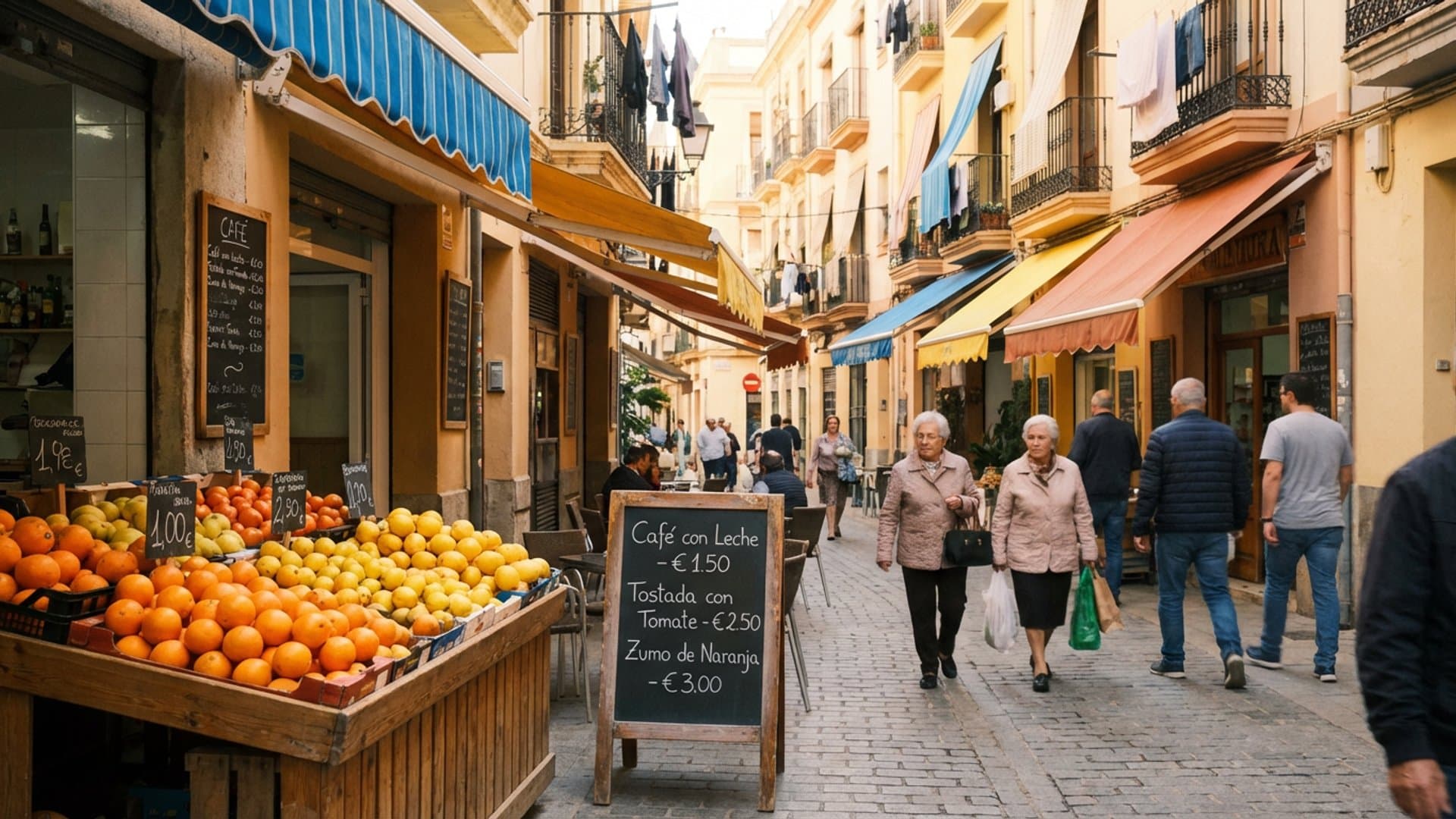
Spanish supermarkets (Mercadona, Lidl, Aldi, Carrefour) are excellent value. Local markets (Atarazanas in Centro) offer better quality produce at similar prices. You'll spend less on groceries than in the US or Northern Europe — and eat better.
Dining out:
| Meal Type | Typical Cost |
|---|---|
| Menú del día (3-course lunch, inc. drink) | €10–14 |
| Tapas dinner for two (3-4 plates, drinks) | €25–40 |
| Coffee and tostada (breakfast) | €2.50–4.00 |
| Beer (caña) at a bar | €1.80–2.50 |
| Nice dinner for two (restaurant, wine) | €50–80 |
| Chiringuito lunch (2 people, seafood) | €30–50 |
Dining out in Málaga is remarkably affordable compared to equivalent quality in the US or UK. The menú del día — a full three-course lunch with bread and a drink for €10–14 — is one of Spain's greatest inventions.
Utilities and Services
| Service | Monthly Cost |
|---|---|
| Electricity | €60–120 (higher in summer with AC) |
| Water | €20–35 |
| Gas (if applicable) | €15–40 |
| Internet (fiber, 300-600 Mbps) | €30–45 |
| Mobile phone | €15–25 (contract with data) |
| Total utilities | €140–265/month |
Electricity is the largest variable — summer AC use can double the bill. Fiber internet is widely available and affordable, with speeds that satisfy remote workers easily.
Transport
| Mode | Cost |
|---|---|
| Bus pass (monthly) | €40 |
| Metro/tram (monthly) | €35–40 |
| Occasional taxi/Cabify | €20–50/month |
| Car insurance (annual, avg.) | €400–700 |
| Gasoline | €1.50–1.70/liter |
| Parking (rented garage) | €80–150/month |
Most people living in Centro, Soho, La Malagueta, or Pedregalejo don't need a car for daily life, reducing transport costs to near zero. Read the full getting around guide for details.
Healthcare
| Coverage | Cost |
|---|---|
| Public healthcare (residents) | Free (covered by Social Security contributions) |
| Private insurance (basic) | €50–100/month per person |
| Private insurance (comprehensive) | €100–200/month per person |
| GP visit (private) | €40–70 |
| Specialist visit (private) | €80–150 |
| Dental cleaning | €50–80 |
Full details in the healthcare guide.
Sample Monthly Budgets
Budget-conscious single person (renting in La Paz or Huelin):
| Category | Amount |
|---|---|
| Rent (1-bed) | €650 |
| Groceries | €200 |
| Dining out (moderate) | €150 |
| Utilities | €140 |
| Transport | €40 |
| Health insurance | €70 |
| Entertainment / misc | €150 |
| Total | ~€1,400/month |
Comfortable couple (renting in Pedregalejo):
| Category | Amount |
|---|---|
| Rent (2-bed) | €1,100 |
| Groceries | €400 |
| Dining out | €350 |
| Utilities | €180 |
| Transport | €40 |
| Health insurance (×2) | €160 |
| Entertainment / misc | €250 |
| Total | ~€2,480/month |
Family of 4 (renting in Teatinos, 1 child in international school):
| Category | Amount |
|---|---|
| Rent (3-bed) | €1,200 |
| Groceries | €550 |
| Dining out | €300 |
| Utilities | €220 |
| Car (insurance, fuel, parking) | €250 |
| Health insurance (family) | €300 |
| International school (1 child) | €500–800 |
| Activities / misc | €300 |
| Total | ~€3,620–3,920/month |
How Málaga Compares
| City | Cost vs Málaga |
|---|---|
| Barcelona | 35–45% more expensive |
| Madrid | 30–40% more expensive |
| Valencia | 5–15% less expensive |
| Lisbon | 15–25% more expensive |
| London | 80–100% more expensive |
| New York | 120–150% more expensive |
| Berlin | 20–30% more expensive |
These are broad estimates based on typical expat lifestyles. The gap widens significantly when you factor in housing, which is Málaga's biggest cost advantage over Barcelona and Madrid.
Next Step
If you want to pressure-test your real budget against the neighborhoods that fit it, Denise can help you sort that out clearly.
If you want examples that match your spending comfort zone, Denise can share selected properties from trusted partner agencies.
Published by Denise Guerrero
FAQ
Is Málaga expensive compared to the rest of Spain?
Málaga is above the Spanish average but below Barcelona and Madrid. It's comparable to Valencia and Seville. Rents have risen sharply in recent years, but daily costs (groceries, dining, transport) remain very reasonable by Western European standards. The further from the city center, the more affordable — La Paz and Huelin are significantly cheaper than Centro or La Malagueta.
Can I live in Málaga on €1,500 a month?
As a single person, yes — but it requires careful budgeting and choosing an affordable neighborhood. €1,500 covers rent in La Paz or Huelin (€600–750), groceries, basic dining, utilities, and transport. There won't be much left for entertainment or savings. For a comfortable single life without financial stress, €2,000–2,500 is more realistic. For couples, €3,000–3,500 allows a comfortable lifestyle.
How much do groceries cost compared to the US or UK?
Generally 20–35% less than the US and 15–25% less than the UK for comparable quality. Fresh produce, olive oil, wine, and seafood are particularly good value in Spain. Imported specialty items (American brands, specific Asian ingredients) cost more and have limited availability.
Is it cheaper to buy or rent in Málaga?
For stays of 3+ years, buying is generally more economical. Monthly ownership costs (community fees, IBI, insurance) for a purchased property are typically €85–350 — well below equivalent rental payments. Of course, buying requires the upfront capital for the purchase price plus 10–13% transaction costs. For shorter stays or uncertain timelines, renting gives flexibility.
How much should I budget for electricity in summer?
Summer AC use can push electricity bills to €100–150/month for a typical apartment, compared to €50–70 in milder months. Properties with good insulation and modern split AC units are more efficient. South-facing apartments with poor insulation can be expensive to cool. Factor this seasonal variation into your budget.
Is private health insurance expensive?
Basic private health insurance costs €50–100/month per person, providing access to private hospitals, shorter wait times, and English-speaking doctors. Comprehensive plans with dental and optical coverage run €100–200. Family plans offer per-person discounts. Full details in the healthcare guide.
How much does international school cost in Málaga?
Annual tuition at international schools in Málaga ranges from approximately €5,000 to €12,000 per child, depending on the school and year group. This is significantly less than international school fees in Barcelona, Madrid, or London. See the international schools guide for specific school information.
Do I need a car in Málaga?
In central neighborhoods (Centro, Soho, La Malagueta, Pedregalejo), no. Daily life is walkable and public transport covers the rest. In El Limonar, yes — a car is essential. In Teatinos and Huelin, the tram reduces car dependence significantly. Full breakdown in the transport guide.
How does the cost of living in Málaga compare to Valencia?
Valencia is approximately 5–15% cheaper overall, with slightly lower rents and dining costs. The gap has narrowed as both cities have grown in popularity. For beachfront living specifically, Málaga's coastal neighborhoods are comparably priced to Valencia's. See the Málaga vs Valencia comparison for a full analysis.
Are there hidden costs of living in Spain that catch people off guard?
The most common surprises: non-resident income tax (you owe tax even on an empty property), community fees that can increase via derramas, higher-than-expected electricity costs in summer, and the gestoria fees (€50–100 per task) for administrative processes that are free or automated in other countries. None of these are deal-breakers, but they should be in your budget.
Is Málaga getting more expensive?
Yes. Rents have increased 15–25% over the past three years in central areas, and property prices have risen across all neighborhoods. This trend is driven by international demand, remote worker migration, and limited housing supply. Málaga is still very affordable compared to most Western European cities, but the direction is clear — buying sooner rather than later locks in current pricing.
What's the best way to reduce costs in Málaga?
Choose a less central neighborhood (La Paz, Huelin, El Palo) for significantly lower rent/purchase prices. Cook at home using Spanish supermarkets and local markets. Use the menú del día for affordable restaurant lunches. Walk or cycle instead of driving. Use public healthcare if you're a resident. And buy rather than rent if you're staying long-term — the ownership cost difference compounds over time. Contact me if you want to discuss budget-friendly neighborhoods for your situation.