
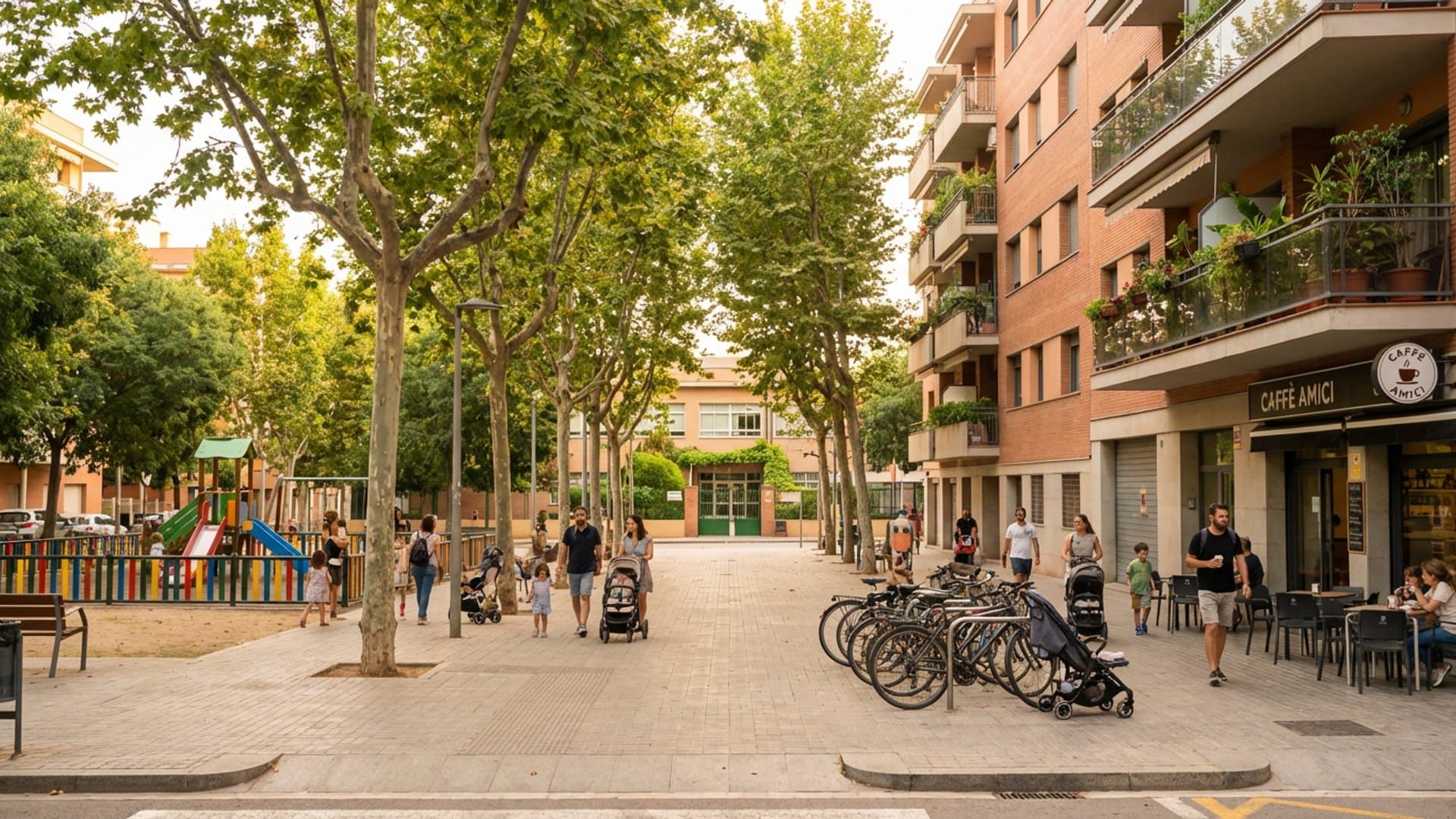
Where Families Thrive in Málaga
Moving to a new city with children changes the equation completely. It's no longer about which neighborhood has the best restaurants or the most charming architecture — it's about school quality and proximity, safe streets for children to play, space to grow, and a community where your family can build genuine connections.
Málaga has three neighborhoods that consistently attract families: Teatinos (modern, well-connected, walkable), El Limonar (spacious villas, school proximity, privacy), and La Paz (authentic, affordable, well-connected). Each serves a different family profile and budget. This guide helps you match your family's priorities to the right neighborhood.
Quick Comparison
| Dimension | Teatinos | El Limonar | La Paz |
|---|---|---|---|
| Price/m² | €2,200–2,800 | €2,500–3,500 | €1,800–2,400 |
| Entry price | ~€200,000 | ~€400,000 | ~€130,000 |
| Property type | Modern apartments, new builds | Villas, detached houses | Older apartments, some townhouses |
| Space | 80–120 m² typical | 150–300+ m² typical | 70–100 m² typical |
| Garden/outdoor | Communal areas, some terraces | Private gardens, pools | Balconies, some small patios |
| International schools | 10–15 min drive/tram | 5–10 min drive | 15–20 min drive |
| Spanish schools | Excellent, walkable | Available nearby | Excellent, walkable |
| Walkability | ★★★★ — flat, wide sidewalks | ★★ — car required | ★★★★ — close to Centro |
| Beach access | 15–20 min drive | 10–15 min drive | 15–20 min walk/bus |
| Car needed? | Helpful but not essential | Yes, absolutely | Not essential |
| Community feel | Young families, modern | Quiet, affluent, private | Local, authentic, warm |
| Vibe | Suburban-modern within the city | Exclusive residential hillside | Traditional Spanish neighborhood |
Schools — The Deciding Factor for Many Families
For families with school-age children, school proximity often determines the neighborhood choice more than any other factor.
El Limonar has the strongest position for international school families. The British School (Colegio Británico de Málaga) and St. George School are within a short drive, making El Limonar the default residential choice for families in the English-language school orbit. The school run is five to ten minutes by car, which is about as good as it gets in Málaga. If your children are attending or will attend an international school, El Limonar removes the school commute as a daily stress point.
Teatinos is well positioned for both international and Spanish schools. Several good colegios públicos and concertados are within walking distance, and the international schools near El Limonar are accessible by tram or a ten to fifteen-minute drive. The university campus is adjacent, adding an educational atmosphere to the neighborhood. Teatinos gives families the flexibility to choose between Spanish and international education without either option requiring a painful commute.
La Paz is strongest for families choosing Spanish-language education. Multiple colegios públicos and concertados are within walking distance, and the neighborhood's primarily Spanish character means children are immersed in the language from school to playground to neighborhood shops. International schools require a fifteen to twenty-minute drive. For families who specifically want full Spanish integration for their children, La Paz offers the deepest immersion.
Space & Living Environment
El Limonar offers the most space by a wide margin. Detached villas with private gardens of 300 to 1,000+ square meters give children room to play outdoors in a safe, private setting. Pools are common. The hillside location means many properties have views. Indoor space is generous — three to five bedrooms is standard. The trade-off for all this space is car dependence and a lack of walkable neighborhood life. Children can play in the garden but can't walk to a friend's house or to the corner shop.
Teatinos offers a modern apartment lifestyle with good communal facilities. Buildings often have rooftop terraces, swimming pools, and play areas shared by residents. Interior space is well-designed — modern layouts with efficient use of square meters mean that 90 to 110 square meters in Teatinos functions as well as a larger footprint in an older building. The neighborhood is flat with wide sidewalks, making it safe and easy for children to walk to school, the park, or a friend's building.
La Paz offers the most affordable space. Apartments are typically 70 to 100 square meters with traditional layouts (separate kitchen, dedicated bedrooms). The buildings are older and less polished than Teatinos, but the floor plans are often generous for the price. Outdoor space is limited to balconies in most cases, though the Ciudad Jardín section has some townhouses with small gardens. The neighborhood's streets and plazas serve as the children's playground — a more traditional, social childhood experience than El Limonar's private gardens.
Daily Life with Children
Teatinos is arguably the easiest neighborhood for daily family logistics. The tram connects to Centro and the shopping districts. The main shopping center (Centro Comercial Larios) is within the neighborhood. Wide, flat streets with modern sidewalks make pushchairs and bikes easy. Parks and green spaces are well-maintained. Everything a family needs — supermarkets, pharmacies, doctors, schools, playgrounds — is accessible without a car. It's the "everything works" option.
El Limonar requires more planning. Every errand, every school run, every playdate involves a car. Social life for children depends on the school community rather than the neighborhood — friends live across the city, and hosting playdates at home (with the garden and pool) replaces the spontaneous neighborhood play that happens in more dense areas. Weekend life often involves driving to Pedregalejo for the beach, to Centro for restaurants, or to the park. It's a comfortable, spacious daily life, but a car-dependent one.
La Paz offers the most traditional Spanish childhood experience. Children walk to school, play in the plaza with neighbors' children, buy chuches (sweets) at the corner shop, and develop the kind of street-level independence that's increasingly rare in modern suburban living. The trade-off is that the infrastructure is older (parks are basic, sidewalks are narrower), and the amenities are simpler than Teatinos' modern offerings. For families who value social integration and independence for their children over polished facilities, La Paz delivers something the other two can't.
Who Should Choose What
Choose Teatinos if you:
- Want modern, hassle-free family living with everything walkable
- Value tram connectivity and don't want to depend on a car
- Have a budget of €200,000–350,000
- Want new-build quality with communal pools and play areas
- Want flexibility between Spanish and international schools
Choose El Limonar if you:
- Need proximity to international schools (British School, St. George)
- Want a villa with a garden and/or pool
- Have a budget of €400,000+
- Value space and privacy over walkability
- Are comfortable with a fully car-dependent daily life
Choose La Paz if you:
- Want the most affordable family option in the city
- Are committed to Spanish-language education and integration
- Value authentic neighborhood community over modern amenities
- Have a budget of €130,000–250,000
- Want to live within walking distance of Centro
Next Step
If school runs, space, and day-to-day logistics are shaping your shortlist, Denise can help you compare the right family neighborhoods quickly.
If you want family-oriented examples, Denise can share selected properties from trusted partner agencies that fit your priorities.
Published by Denise Guerrero
FAQ
Which family neighborhood is most affordable?
La Paz is the most affordable by a significant margin, with two-bedroom apartments starting around €130,000 and three-bedrooms available from €160,000. Teatinos is mid-range, starting around €200,000 for a modern two-bedroom. El Limonar is the most expensive, with entry starting around €400,000 for a semi-detached villa.
Which is safest for children?
All three are safe residential neighborhoods with low crime and family-oriented communities. El Limonar is the most physically secure — private plots behind walls and gates, no through-traffic on residential streets. Teatinos has modern, well-lit streets with good pedestrian infrastructure. La Paz is safe in the standard urban sense — a functioning neighborhood where people look out for each other's children.
Can I walk to the beach from any of these neighborhoods?
Not comfortably from any of the three — these are inland/elevated neighborhoods, not beachfront. From La Paz, Huelin beach is about fifteen to twenty minutes' walk or a quick bus ride. From Teatinos, the nearest beach is fifteen to twenty minutes by car or tram. From El Limonar, Pedregalejo beach is a steep ten to fifteen-minute walk downhill (and a serious walk back up) or a three-minute drive. For beach-focused family living, consider Pedregalejo instead.
Which has the best parks and playgrounds?
Teatinos has the most modern parks and playground facilities, including several well-equipped children's play areas and the green spaces around the university campus. El Limonar residents have private gardens instead of public parks — the trade-off is privacy vs. social play. La Paz has traditional neighborhood plazas and parks that are functional but less polished than Teatinos' newer facilities.
Which is best for a single-income family?
La Paz is the clearest choice for families managing on one income. The combination of the lowest purchase prices in the city, low monthly costs (community fees, utilities, IBI), good public schools within walking distance, and no need for a car makes it the most financially accessible family option. The savings compared to Teatinos or El Limonar can be redirected to education, travel, or building financial reserves.
Do children integrate easily in each neighborhood?
In La Paz and Teatinos, children integrate quickly through school communities and neighborhood play. La Paz offers the deepest Spanish integration because the neighborhood is predominantly Spanish-speaking. Teatinos has a mix of Spanish and international families. El Limonar's integration depends more on the school community than the neighborhood itself — social circles form at school, not on the street, because the neighborhood's villa-and-garden format doesn't encourage spontaneous interaction between children.
What about extracurricular activities?
Teatinos has the best access to organized activities — sports clubs, dance academies, language schools, and the university's community programs are all within the neighborhood or a short tram ride. El Limonar families typically drive children to activities elsewhere in the city. La Paz has local options (neighborhood sports clubs, cultural centers) that are more affordable and more integrated into the community.
Can I rent before buying in these neighborhoods?
Yes, and it's highly recommended for families — spending three to six months renting lets you test the school commute, the neighborhood rhythm, and your children's social experience before committing financially. Rental availability is strongest in Teatinos (many apartments, regular turnover), moderate in La Paz (less international demand, local rental market), and limited in El Limonar (few rental villas, long tenancies).
Which is best for two children, ages 8 and 12?
At these ages, school quality and social opportunity are paramount. Teatinos offers the best balance: modern housing, walkable for pre-teen independence, good schools both Spanish and international, and age-appropriate activities accessible without a car. El Limonar works well if international school proximity is the top priority and you're comfortable driving for everything. La Paz works well if you want an affordable base with full Spanish immersion and your children are adaptable.
What about healthcare access?
All three neighborhoods have good access to healthcare. Teatinos is closest to the large public hospitals (Hospital Regional Universitario de Málaga and Hospital Clínico) and has multiple pediatric clinics. La Paz is close to the same hospital cluster. El Limonar is slightly further but still within ten minutes' drive of major hospitals and has private clinic options nearby.
Which neighborhood is best if we might only stay 2–3 years?
Teatinos is the most practical for a potentially shorter stay. Modern apartments are easy to rent out when you leave, the rental market is liquid, and you avoid the higher transaction costs of a villa purchase in El Limonar. La Paz properties are affordable to acquire but may take longer to sell when you leave. El Limonar villas are significant commitments that make more sense for families planning five or more years.
Is Pedregalejo a better family option than all three of these?
Pedregalejo is an excellent family neighborhood — arguably the best if beach access is a priority. But it lacks the international school proximity of El Limonar, the modern housing stock of Teatinos, and the affordability of La Paz. Pedregalejo's sweet spot is families who want beach life, village community, and a mixed international-Spanish social environment, and who are comfortable with a ten to fifteen-minute school drive. It's a strong fifth option that complements rather than replaces the three compared here.
Keep Comparing
Málaga City vs Costa del Sol
Should you buy in Málaga city or the Costa del Sol? Honest comparison of lifestyle, prices, community, and investment potential. Expert buyer guide.
Centro vs La Malagueta vs Soho
Choosing between Centro Histórico, La Malagueta, and Soho? Compare lifestyle, prices, walkability, and vibe to find your perfect Málaga neighborhood.
Beach Neighborhoods
Compare Málaga's three most affordable beach neighborhoods. Pedregalejo, El Palo, and Huelin offer coastal living from €150K. Find your fit.
Where to Buy by Budget
From €130K to €1M+ — find the best Málaga neighborhood for your budget. Every price bracket mapped to specific neighborhoods with honest expectations.
Practical buying process guides
What Happens After Purchase
You bought property in Málaga — now what? Setting up utilities, empadronamiento, insurance, community registration, residency steps, and ongoing obligations.
Community Fees Explained
What are community fees in Spain? How much they cost, what they cover, how they work, and what to check before buying an apartment. Practical owner's guide.
The practical day-to-day layer
International Schools
Every international school option in Málaga: British, American, German, and IB curriculum. Fees, locations, languages, and which neighborhoods to live in.
Healthcare for Expats
How healthcare works in Spain for expats: public system access, private insurance, English-speaking doctors, and what to do in an emergency. Practical guide.